Téléphone : +41 22 757 67 57 frontdesk@dev.destination-montagne.ch

[:fr]Un autre jour au sentier panoramique du Gantrisch[:en]Another day on the Gantrisch panoramic trail[:de]Ein anderer Tag am Gantrisch-Panoramaweg[:]

[:fr]

Le Gantrisch est à la fois une région et un sommet. Le sommet se trouve le long de la première crête des Préalpes longeant le Niedersimmental vers le nord. Etonnamment, il ne s’agit pas du plus haut sommet de cette chaîne puisque le Stockhorn et le Ochse sont plus élevés. Cependant, la si particulière morphologie du sommet du Gantrisch est probablement la raison pour laquelle il a conféré son nom à la région se trouvant au nord de cette chaîne.

La partie nord de la région du Gantrisch, ainsi que la voisine Rüschegg, a été formée durant le tertiaire et est constituée de molasse, et en partie de conglomérat. Il en résulte une morphologie complexe formée de vallons encaissés et de crêtes peu propices à l’agriculture. C’est une des raisons pour laquelle Rüschegg était la région la plus pauvre du canton de Berne. La partie sud de la région du Gantrisch est formée de calcaires et présente un contraste de paysage avec sa voisine du nord. Entre les deux parties coulent vers l’ouest, la Kalte Sense et vers l’est, la Gürbe. La ligne de partage des eaux se trouve au Gurnigelpass.

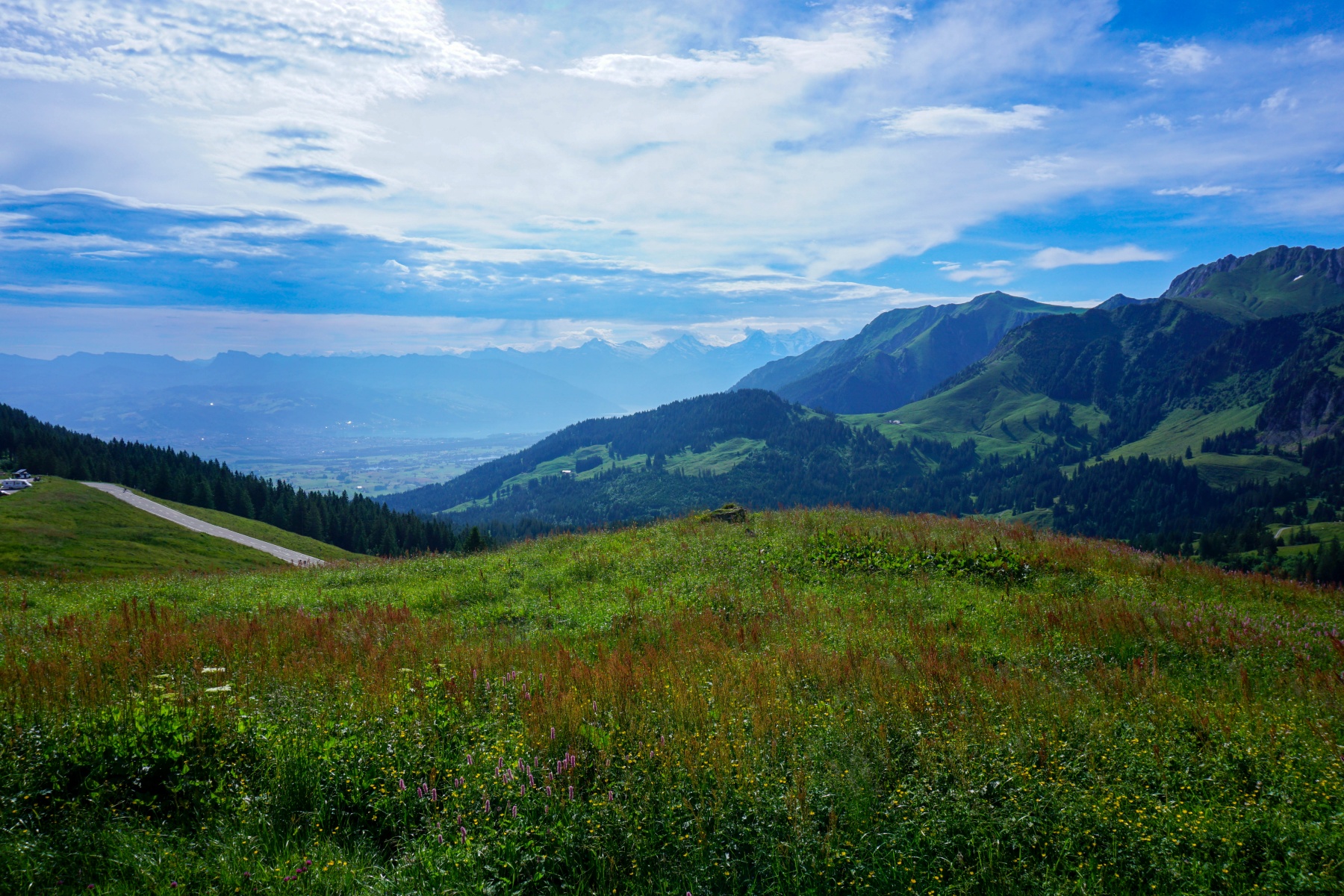
Cette randonnée suit la longue arête longeant le nord de la région du Gantrisch. L’itinéraire numéroté du sentier panoramique qui suit cette arête, part depuis Gurnigelbad pour rejoindre Zollhaus. Comme cela aurait fait un trop gros morceau, nous sommes partis de la Stierenhütte pour suivre cet itinéraire. En revanche, nous n’avons pas fidèlement suivi l’itinéraire, car nous sommes montés au Selibüel, petit sommet présentant une belle vue sur la région de Thun. Depuis ce petit sommet, un sentier, non balisé mais bien marqué au sol, descend le long de la crête pour rejoindre l’itinéraire précité.

Les points de vue le long de cette arête sont assez rares, car la crête est boisée. Çà et là cependant, on a un peu de vue sur le plateau Suisse. Un peu plus loin, on traverse le Gäggersteg, qui est une construction en bois permettant de marcher au-dessus du sol de la forêt. Cette construction avait été réalisée à la suite de l’ouragan Lothar qui, en décembre 1999, avait causé énormément de dégâts aux forêts. Cette construction permet au public de constater comment une forêt peut se remettre d’un tel événement.

En continuant le long de l’arête, on passe non loin de la Cheeserehöhle, une curieuse grotte plongeant dans les entrailles de la terre et liée à une légende. Elle se situe peu avant d’entamer la descente en direction de Zollhaus. Là, la vue s’élargit sur la région du Lac Noir.

Itinéraire : Gurnigel (Stierenhütte) – Selibüel – Schüpfeflue – Schwarzenbühlpass – Gäggersteg – Pfyffe – Horbüelpass – Mittlere Seite – Zollhaus
Distance : 16Km
Dénivellation : 530m positifs/1270m négatifs
Durée : 5h30
[:en]

The Gantrisch is both a region and a mountain. The mountain is located along the first ridge of the Prealps running north from the Niedersimmental. It is not the highest top in this range, as the Stockhorn and the Ochse are higher, but the special morphology of the Gantrisch summit probably gave its name to the region to the north of this ridge.

The northern part of the Gantrisch region, as well as the neighbouring Rüschegg, was formed during the Tertiary and is made up of molasse and partly conglomerate. This results in a complex morphology of narrow valleys and ridges that are not very suitable for agriculture. This is one of the reasons why Rüschegg was the poorest region in the canton of Bern. The southern part of the Gantrisch region is made up of limestone and forms a contrast to the northern part. The Kalte Sense flows to the west and the Gürbe to the east. The water divide is at the Gurnigelpass.

This hike follows the long ridge running along the northern part of the Gantrisch region. The numbered trail of the panorama trail that follows this ridge starts at Gurnigelbad and ends at Zollhaus. As this would have been too much, we started at the Stierenhütte and followed this trail. However, we did not follow the trail exactly, as we went up to the Selibüel, a small summit with a good view of the Thun region. From this small summit, a trail, not marked but well-identifiable on the ground, leads down along the ridge to the above-mentioned trail.

The viewpoints along this ridge are quite rare, as the ridge is wooded. However, there are a few glimpses of the Swiss Plateau here and there. A little further on, we cross the Gäggersteg, which is a wooden construction that allows one to walk above the forest floor. This construction was built after the hurricane Lothar in December 1999, which caused a lot of damage to the forests. This construction allows the public to see how a forest can recover from such an event.

Continuing along the ridge, one will pass close to the Cheeserehöhle, a peculiar cave that leads deep into the earth and is connected to a legend. It is located just before the descent towards Zollhaus begins. Here, the view opens to the region of the Schwarzsee.

Route: Gurnigel (Stierenhütte) – Selibüel – Schüpfeflue – Schwarzenbühlpass – Gäggersteg – Pfyffe – Horbüelpass – Mittlere Seite – Zollhaus
Distance: 16km
Elevation gain: positive 530m/negative 1270m
Duration: 5h30

[:de]

Der Gantrisch ist sowohl eine Region als auch ein Gipfel. Der Gipfel liegt entlang der ersten Kette der Nordalpen, die das Niedersimmental nach Norden hin begrenzt. Erstaunlicherweise ist er nicht der höchste Gipfel dieser Kette, denn sowohl das Stockhorn als auch der Ochse sind höher. Aber wahrscheinlich ist es die besondere Morphologie des Gantrisch-Gipfels, die der Region nördlich dieser Kette ihren Namen gegeben hat.

Der Norden der Gantrisch-Region sowie die Nachbargemeinde Rüschegg sind tertiär gebildet und bestehen aus Molasse und teilweise Konglomerat. Dies führt zu einer komplizierten Morphologie mit engen Tälern und landwirtschaftlich wenig nutzbaren Hügeln. Dies ist einer der Gründe, weshalb Rüschegg die ärmste Region des Kantons Bern war. Der Süden der Gantrisch-Region ist aus Kalkstein gebildet und bildet einen Kontrast zur Nachbargemeinde im Norden. Die Kalte Sense fliesst nach Westen und die Gürbe nach Osten. Die Wasserscheide liegt am Gurnigelpass.

Diese Wanderung folgt der langen Gratlinie nördlich der Gantrisch-Region. Der nummerierte Weg des Panoramawegs, der entlang dieser Gratlinie verläuft, führt von Gurnigelbad nach Zollhaus. Da dies zu lang gewesen wäre, sind wir von der Stierenhütte aus gestartet und haben diesen Weg gewandert. Wir sind jedoch nicht dem Weg treu geblieben, sondern sind auf den Selibüel, einen kleinen Gipfel mit schöner Aussicht über die Region Thun, hinaufgestiegen. Von diesem kleinen Gipfel führt ein nicht markierter, aber gut erkennbarer Pfad entlang der Gratlinie hinunter zum oben erwähnten Weg.

Die Aussichtspunkte entlang dieser Gratlinie sind eher spärlich, da der Grat bewaldet ist. Hier und da hat man jedoch einen Blick auf das Schweizer Flachland. Weiter quert man den Gäggersteg, eine Holzkonstruktion, die es ermöglicht, über dem Waldboden zu wandern. Diese Konstruktion wurde nach dem Orkan Lothar im Dezember 1999 errichtet, der in den Wäldern enorme Schäden angerichtet hatte. Diese Konstruktion ermöglicht es der Öffentlichkeit, zu sehen, wie sich ein Wald von einem solchen Ereignis erholt.

Wenn man weiter auf dem Grat entlangwandert, kommt man in die Nähe der Cheeserehöhle, eine merkwürdige Höhle, die in die Tiefen der Erde führt und mit einer Sage verbunden ist. Sie liegt kurz vor dem Abstieg nach Zollhaus. Dort bietet sich ein weiter Blick auf die Region des Schwarzsees.

Route: Gurnigel (Stierenhütte) – Selibüel – Schüpfeflue – Schwarzenbühlpass – Gäggersteg – Pfyffe – Horbüelpass – Mittlere Seite – Zollhaus
Distanz: 16km
Höhendifferenz: 530m aufwärts/1270m abwärts
Dauer: 5h30

[:]

Laisser un commentaire

Votre adresse e-mail ne sera pas publiée. Les champs obligatoires sont indiqués avec *